
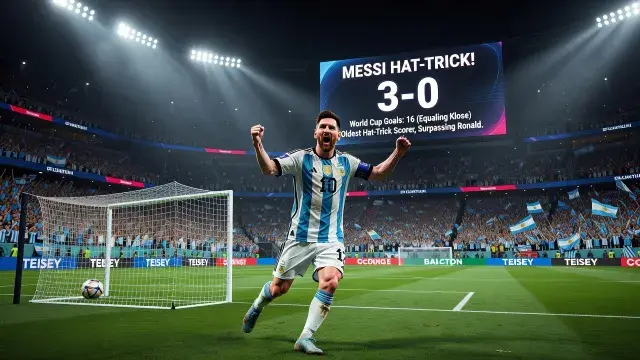
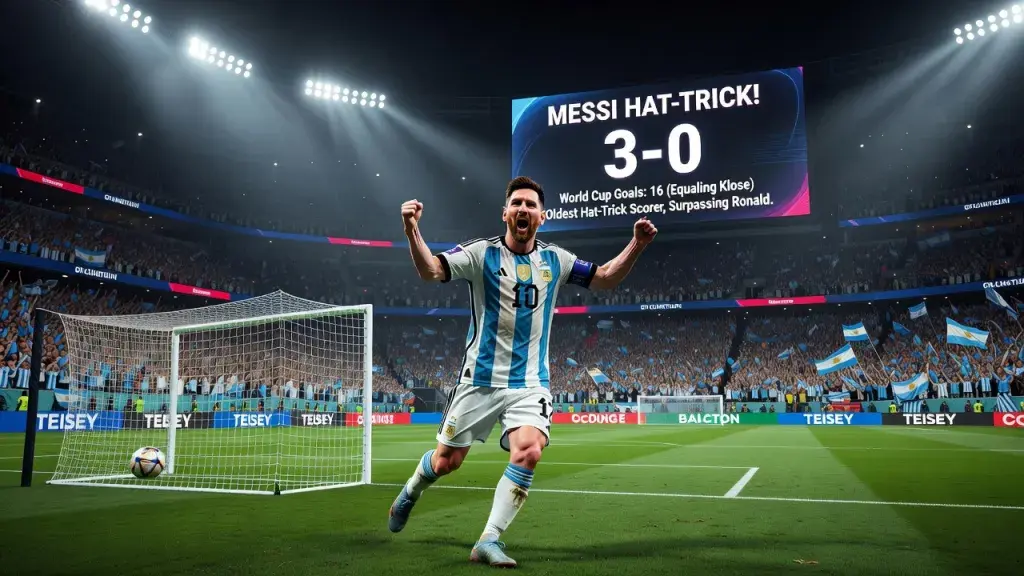
Lionel Messi announced himself at the 2026 World Cup in the most emphatic fashion possible, scoring a hat-trick against Algeria in Argentina's opening group stage match to rewrite the record books once more. The performance, arriving on his 200th international cap, silenced any lingering questions about whether the Inter Miami forward still belongs at football's highest stage. At 38, with his 39th birthday days away, the answer was unambiguous.
Messi's three goals moved him level with Miroslav Klose as the all-time leading scorer in World Cup history with 16 goals, while simultaneously breaking Cristiano Ronaldo's record to become the oldest player to score a hat-trick at the tournament. It was also the first time Messi had achieved the feat across his six World Cup appearances - a number no other player in history can match. That combination of longevity and peak output is a story that stretches well beyond the football pitch, in much the same way that sports fans across disciplines have been captivated by the late-career brilliance of athletes who refuse to concede to time - something Messi himself referenced post-match, drawing a comparison to Rafael Nadal's famous competitive drive. For readers who follow sport across multiple disciplines, from football to, say, belarus liga pro volleyball, the theme of elite athletes maximising every remaining moment of their careers resonates universally. belarus liga pro volleyball
Speaking to ESPN after the final whistle, an emotional Messi reflected on the occasion with characteristic sincerity. "I never imagined everything I've achieved, both as a team and individually," he said. "It's so much more than I could have imagined as a kid. I've been through some tough days... I'm enjoying this, I feel great and happy on the pitch." When asked about the prospect of a seventh World Cup, he laughed before adding: "No, I don't know... now I enjoy being on the pitch. I like to compete, to be up to the task." There was no grandstanding, no manufactured drama - just a man who clearly still loves the game, and is still exceptionally good at it.
How Inter Miami Built the Perfect Environment for Messi's Late-Career Renaissance
The hat-trick against Algeria did not emerge from nowhere. It is the product of a carefully managed club environment that has allowed Messi to perform and recover in a way that European football's relentless calendar increasingly makes impossible for ageing elite players. At Inter Miami last season, Messi scored 43 goals across all competitions - his most prolific single campaign since 2019 - while logging just 2,421 minutes of MLS league action. That minute tally was the second-lowest of his career since a teenage season at Barcelona in 2006/07, a figure that tells its own story about how intelligently the club and their medical staff have managed him.
The MLS structure suits a player of Messi's profile. The league does not carry the relentless fixture congestion of the Premier League, La Liga or Serie A, and Inter Miami have been willing to give their talisman the freedom to roam the attacking third without pressing or defensive tracking obligations - a tactical concession that would be harder to justify in Europe but makes obvious sense here. The system works: Miami won their first ever MLS Cup last December, with Messi leading from the front. He then enjoyed nearly three months away from club football before starting the 2026 season in late February, arriving at this World Cup on the back of 13 goals in 16 games, physically fresh and tactically sharp.
The Rest Advantage - and What It Says About Modern Football's Calendar Problem
The contrast with many of Argentina's opponents at this tournament is striking. Several European-based players will have come into the 2026 World Cup having navigated an almost unbroken stretch of elite club football - Euro 2024, the expanded Club World Cup last summer, and a full domestic season - with little more than two or three weeks of meaningful rest at any point in the cycle. Messi, by comparison, was rested, rhythmic and, crucially, injury-free going into the tournament despite a minor scare: he had been substituted in Inter Miami's final pre-tournament match with muscle soreness and a mild hamstring strain. The short recovery window proved sufficient.
The tournament's North American staging also removes a variable that could have worked against him. Travel time for the Argentina squad is minimal compared to a tournament hosted in Europe or Asia, and Messi, based in Miami, has had no meaningful time zone disruption. These are marginal gains, but at 38, marginal gains accumulate into decisive advantages.
A Defence of the World Cup Title - and the Weight of What Comes Next
Argentina arrived in North America as defending champions, and the magnitude of what a second consecutive title would represent is not lost on Messi or his teammates. "Do I know there are only two two-time World Cup champions?" he said after the Algeria match. "Yes, but we have to keep going like this, give everything for the team, and we'll see." That measured, team-first framing is consistent with Messi's approach throughout his international career - the obsessive individual brilliance always channelled into collective purpose.
One match does not define a tournament, and Algeria, while competitive, are not the sternest test Argentina will face before a potential final. The knockout rounds will demand more. But if the opening performance is any indicator, Messi is entering this World Cup in the best possible condition - mentally free, physically available, and still capable of moments that belong in a different category entirely. Whether this is genuinely his final World Cup or not, he is treating it as though every minute matters. The records, the milestones, the hat-tricks - they keep arriving not because he is chasing them, but because he is still, at nearly 39, simply one of the best footballers on the planet.


