

A freshly created Gmail account is, in many practical contexts, a liability before it becomes an asset. New accounts face sending restrictions, trigger verification prompts on third-party platforms, and carry no accumulated trust with automated systems that evaluate account age as a legitimacy signal. For professionals who depend on email infrastructure - marketers, developers, agencies, and businesses managing multiple digital identities - this waiting period is not a minor inconvenience. It is a real operational constraint that costs time and limits capability.
Aged Gmail accounts solve this problem by arriving with an established history already in place. The trust signals, the platform compatibility, the reduced friction with external services - these qualities take months or years to build organically, and they are precisely what makes established accounts valuable. For those who need that head start, the ability to buy aged Gmail accounts from a reputable source represents a practical shortcut that experienced professionals have relied on for years. Platforms that verify account age, provide documented activity histories, and offer buyer protections make this process far more reliable than informal channels.
But the market is uneven. Alongside credible sellers, there are unverified sources offering accounts with inflated age claims, hidden histories, or credentials that have already been sold to multiple buyers. Knowing how to tell these apart - and how to secure and maintain an account properly after purchase - is the difference between a valuable asset and a fast loss. This guide covers every stage of that process in practical, specific terms.
What Are Aged and Vintage Gmail Accounts and Why Do They Matter?
The word "aged" in the context of Gmail accounts refers to accounts created a meaningful amount of time ago - typically at least one year, though the threshold varies depending on the use case. "Vintage" accounts, a term that overlaps with aged but often implies greater maturity, usually describe accounts five or more years old with richer usage histories and deeper integration into the broader ecosystem of associated services.
What makes these accounts functionally different from new ones comes down to how trust is assigned by automated systems. When an account is first created, it sits in an observation window. Sending limits are lower. Requests to access third-party platforms through account authentication may be met with additional review steps. Spam filters on receiving servers apply more scrutiny to mail originating from new accounts with no delivery history. None of this is permanent for any individual account - but it does mean that a new account requires time and consistent activity before it performs like a mature one.
An aged account has already cleared these hurdles. The observation window has passed. The account's identity, so to speak, has been established. When someone chooses to acquire aged Google accounts rather than build from scratch, they are effectively purchasing the outcome of that establishment process - the accumulated trust, the cleared thresholds, the behavioral profile that signals legitimate use rather than newly created infrastructure.
Activity history also matters beyond account age alone. An account that was created four years ago but never used carries less inherent credibility than one that has been actively receiving mail, logging into associated services, and engaging with the broader platform. The combination of age and authentic activity produces the strongest foundation. When evaluating whether to buy vintage Gmail accounts, buyers should ask about both dimensions - not just when the account was created, but how it was used in the interim.
- Account creation date - the foundational measure of age that third-party systems and internal algorithms use as a trust signal
- Activity history - the record of consistent, organic use that differentiates a genuinely seasoned account from one that was simply created and left dormant
- Associated service usage - prior engagement with connected platforms such as cloud storage, video, or mapping services that adds depth to an account's profile
- Spam and policy record - whether the account has accumulated any complaints, warnings, or violations that would undermine its apparent age advantage
- Platform access compatibility - how smoothly the account authenticates with third-party tools that check account age or history during sign-in
Legitimate Use Cases for Purchasing Aged Gmail Accounts
The decision to purchase aged Gmail accounts is not inherently problematic. There are clear, legitimate scenarios in which doing so makes practical sense, and understanding these use cases helps buyers approach the market with appropriate clarity about their own goals.
Business and Marketing Applications
Email outreach is one of the most common and operationally valid reasons to seek aged accounts. Professionals running outbound campaigns understand that sender reputation affects deliverability directly. An account with established age and a clean history is more likely to land in a recipient's inbox than one that was created last week. For agencies managing campaigns across multiple clients, or for businesses testing different messaging strategies with separate sender identities, pre-aged Gmail accounts offer a functional advantage that is difficult to replicate quickly through organic account building.
Marketing teams also use aged accounts as the anchor identity for associated advertising tools and analytics platforms. Some advertising systems assign trust levels to the connected account, not just to the ad account itself. An older, activity-rich Gmail identity can reduce review times and friction when setting up new campaigns on platforms that perform background checks on the linking account.
Platform Verification and Access Requirements
Many platforms that authenticate users through their accounts apply internal checks that go beyond simply confirming valid credentials. Account age, associated activity, and linked services are all signals that some platforms evaluate during the authentication process. Newer accounts frequently encounter additional verification steps, review queues, or outright rejection from platforms with stricter onboarding filters.
For professionals who need immediate access - developers testing integrations, businesses onboarding to new tools, or individuals registering for services with account age requirements - buying old Gmail accounts provides access that a freshly created account simply cannot offer on day one. The account's existing profile satisfies the implicit or explicit requirements that newer accounts fail to meet.
Backup and Redundancy for Online Operations
Any professional who depends significantly on email-based access to critical systems should maintain backup account options. Single-account dependency creates a vulnerability: if that account is locked during a routine security review, access to associated services, linked platforms, and stored communications can disappear simultaneously. Maintaining one or more aged backup accounts ensures that operations can continue while a primary account issue is resolved.
Aged accounts work better as backups than newly created ones because they will not trigger suspicion from systems that monitor for freshly created accounts attempting to access established service profiles. An aged account used sparingly as a backup blends into normal usage patterns far more effectively.
- Outbound email campaigns where deliverability depends on sender account history
- Multi-client agency account management requiring separate established identities
- Third-party platform access where authentication systems favor older accounts
- Developer environments requiring stable, mature accounts for testing
- Operational redundancy to maintain continuity if a primary account is temporarily suspended
- Personal privacy scenarios where an established identity is preferable to a newly created one
Understanding the Risks Before You Buy Old Gmail Accounts
Every market has its weak points, and the market for aged Gmail accounts is no different. The risks are real, but they are also manageable for buyers who understand them before making any financial commitment. Approaching this with open eyes is what separates a safe acquisition from an avoidable mistake.
Account Quality and History Risks
Age alone does not guarantee quality. An account that was created years ago but was used for bulk unsolicited messaging, associated with flagged IP addresses, or previously penalized for policy violations carries that history forward. The account may still appear functional on the surface - accessible, appearing old in its creation metadata - but its underlying reputation may be damaged in ways that surface quickly once you begin using it. Deliverability suffers, platforms flag it during sign-in, and in some cases the account is suspended within days of high-volume use resuming.
This is why account history documentation is not optional. When you buy pre-aged Gmail accounts, you are not just buying a date - you are buying a behavioral record. That record should be verifiable, at least partially, through the account's own internal evidence.
Seller Fraud and Marketplace Scams
Informal channels for buying aged accounts - forums, social media groups, anonymous messaging platforms - carry significant fraud risk. Sellers on these channels have little accountability. Age claims may be fabricated. The same credentials may be sold to multiple buyers at once, meaning the account is worthless before the second buyer ever logs in. Payment is typically collected before delivery, and without a structured dispute mechanism, recovery of funds after a fraudulent transaction is difficult.
The remedy is straightforward: avoid informal channels entirely. Established marketplaces with verifiable seller ratings, published refund or replacement policies, and a documented track record of transactions provide a substantially safer environment for anyone looking to acquire aged Google accounts at scale or even for a single purchase.
Terms of Service Considerations
The transfer of Gmail accounts between individuals is not a practice that the platform officially supports. Its policies are designed around the concept of individual account ownership, and commercial resale of accounts is outside the intended use model. This is a policy consideration, not a legal one in most jurisdictions, but it is relevant because it means that account suspensions resulting from policy enforcement are not appealable on the grounds that the buyer acted in good faith. The risk sits with the buyer, and understanding this context helps calibrate how accounts should be used after purchase - conservatively, legitimately, and without the kinds of high-volume or automated activity that most commonly trigger policy reviews.
Recovery and Access Security Risks
One of the most underappreciated risks in any account purchase is the original owner's residual access. If the account's recovery phone number, backup email address, or security answers still point to the previous owner, that person retains a pathway back into the account. This can be exploited intentionally - some sellers recover and resell the same account multiple times - or it can happen unintentionally if the original owner attempts to access the account through habit or confusion after the sale.
The solution is to treat recovery option replacement as the very first post-purchase task, before any other use of the account begins. An account whose recovery channels have not been secured is not truly yours, regardless of what credentials you were given.
| Risk Category | Description | Impact Level | Mitigation Strategy |
|---|---|---|---|
| Account history issues | Prior spam activity or policy violations embedded in account record | High | Request verifiable activity documentation before completing purchase |
| Seller fraud | Fabricated age claims, duplicate credential sales, inaccessible accounts post-payment | High | Purchase only through verified marketplaces with published buyer protections |
| Terms of Service exposure | Account transfer outside official policy; suspension risk under enforcement | Medium | Use accounts for legitimate purposes; avoid bulk or automated abuse patterns |
| Recovery access retained by original owner | Previous owner can trigger recovery and reclaim account | High | Update all recovery credentials immediately after receiving access |
| Compromised credentials | Password already shared with multiple buyers or previously exposed | High | Change password and enable two-factor authentication before any other use |
How to Evaluate and Choose a Trustworthy Seller
Seller selection is the most consequential decision in the entire process of buying aged Gmail accounts. A credible seller reduces every category of risk described above. An unreliable one amplifies them. The good news is that distinguishing between the two is not difficult once you know what to look for.
Key Indicators of a Reputable Marketplace or Seller
Established marketplaces that specialize in aged digital accounts share several characteristics. They publish explicit account specifications - creation date, activity level, recovery option status, associated phone number inclusion - before the buyer commits to a purchase. They have a documented refund or replacement policy that is accessible without requiring you to ask for it. Their seller ratings and transaction histories are visible and verifiable through buyer feedback that reads like genuine experience rather than generic praise.
Pricing is one of the more reliable proxy signals. Aged accounts with clean histories, verified age, and associated recovery assets require real sourcing effort and quality control. That effort is reflected in price. When an account is offered at a price that seems conspicuously low relative to comparable listings, the most likely explanation is that something about the account - its true age, its history, its exclusivity - does not match the description. Chasing the cheapest option in this market is a reliable way to encounter problems.
Questions to Ask Before Completing a Purchase
Treating the pre-purchase stage as a qualification process protects the buyer and simultaneously reveals how accountable the seller is willing to be. Any seller with legitimate inventory should be able to answer these questions clearly and specifically.
- What is the exact account creation date, and will this be independently verifiable after login through internal account evidence?
- How was the account used previously, and is there any documentation of sending history or platform activity?
- Are any recovery options - phone number, backup email - still linked to the original owner, and how will these be resolved at handover?
- Is the associated phone number included in the sale, and if so, is it transferable?
- What is the specific replacement or refund policy if the account becomes inaccessible or suspended within a defined period following purchase?
- Has the account received any warnings, spam flags, or policy notices during its history?
- Will credentials be delivered exclusively - confirmed as not shared with any other buyer simultaneously?
Red Flags That Signal an Untrustworthy Seller
- No verifiable transaction history or only vague, unverifiable testimonials provided as proof of reliability
- Refusal to provide any internal account documentation or specific creation date evidence prior to payment
- Pricing that falls well below the established market range for the claimed account age and specifications
- No written refund or replacement policy - only verbal assurances
- Delivery through informal channels only, with no structured transaction platform or dispute mechanism
- Pressure to complete the transaction quickly, framed as limited availability or expiring offers
- Inability to answer specific questions about account history, recovery options, or credential exclusivity
Step-by-Step Process for Safely Purchasing an Aged Gmail Account
A structured purchase process is what separates buyers who consistently acquire usable, secure accounts from those who encounter problems repeatedly. Each step in this sequence exists because skipping it creates a specific, predictable problem. Follow the full sequence regardless of how straightforward a given transaction appears.
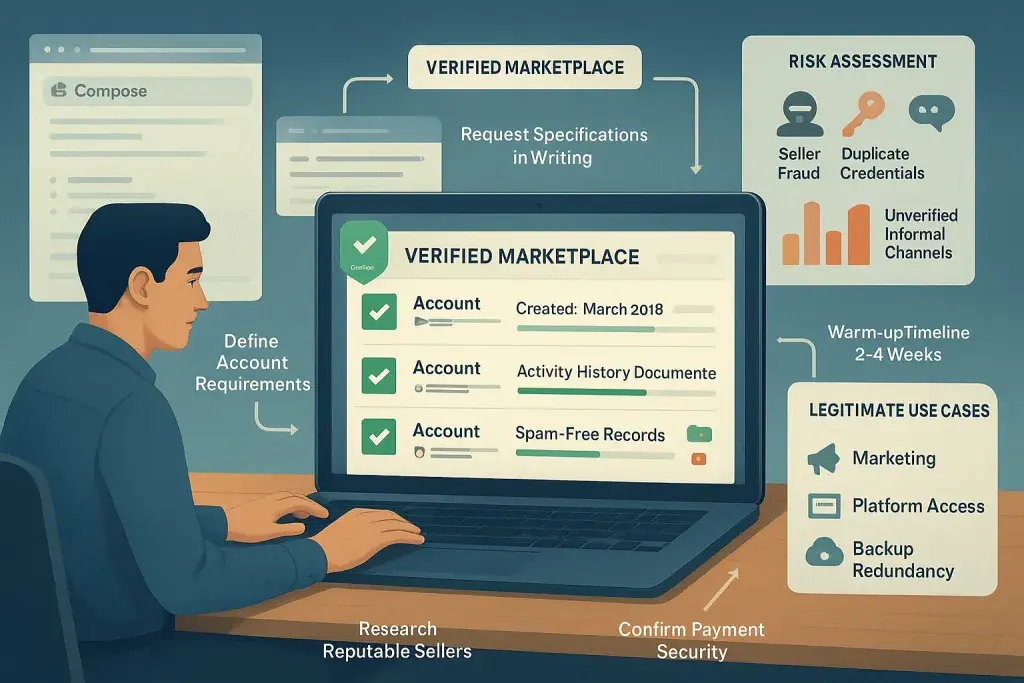
- Define your requirements before approaching any seller. Establish the minimum account age, whether a linked phone number is necessary, what level of activity history you need, and how the account will be used. Vague requirements lead to purchases that technically match general descriptions but fail to serve the actual purpose.
- Research and shortlist verified sellers. Identify two or three established platforms based on visible transaction histories, buyer feedback, and published account specifications. Cross-reference seller reputation through independent channels where possible rather than relying solely on the platform's own presentation.
- Request full account specifications in writing before any payment. Obtain the creation date, activity summary, recovery option status, and details of any included assets - phone number, backup email - in documented form. This creates a record against which you can verify the account after receiving access.
- Confirm payment security and dispute options. Use payment methods that offer a resolution pathway if the transaction goes wrong. Avoid irreversible payment channels for first-time transactions with sellers you have not used before.
- Receive credentials through a documented, secure channel. Credentials should be delivered in a way that creates a record of the exchange and confirms that the login details are exclusive to this transaction.
- Log in immediately and verify the account against the documented specifications. Check the creation date through internal account evidence, review any existing activity, and confirm that no recovery options still point to the previous owner.
- Complete all security updates before any other use. Change the password, update recovery email and phone number to your own, enable two-factor authentication, and check active sessions for any devices that are not yours.
- Run a gradual warm-up period before intensive use. Introduce activity incrementally over one to three weeks - organic sending, inbox management, and platform access at modest volume - before deploying the account for any high-volume or automated purpose.
Verifying Account Age, Quality, and Security After Purchase
Receiving credentials completes the transaction, but it does not complete the acquisition. What happens in the first hours after login largely determines whether the account will serve its intended purpose or create problems down the line. Verification is the step most buyers rush or skip - and it is the step where most post-purchase problems originate.
Confirming Account Age and Creation Date
The claimed creation date should be independently verifiable through the account's own internal evidence. Several signals provide reliable age confirmation. The oldest emails in the inbox establish a floor date for account activity. If the account has connected services - cloud storage files with early creation timestamps, activity in associated video or mapping services, or content uploaded years ago - these provide additional data points that corroborate or contradict the seller's claimed age.
If none of the internal evidence supports the claimed creation date, this discrepancy should be raised with the seller before the transaction window closes. Credible sellers will address the inconsistency; others will not respond at all, which tells you everything you need to know about the sale.
Assessing Account Health and Activity History
Beyond the creation date, the account's behavioral record matters. Review the sent mail folder carefully. Patterns of high-volume outbound messaging, repetitive template-style emails, or unusual recipient lists are signs that the account was previously used for bulk sending - an activity that leaves lasting marks on deliverability reputation regardless of how much time has passed. Check whether the account has an elevated number of items in spam categories or shows signs of prior filtering adjustments.
An account with a clean, modest history of regular use is far more valuable than one with years of age but a troubled activity record. The history cannot be erased, so understanding what it contains before you rely on the account is essential.
Immediate Security Hardening Steps
Security hardening is not a recommended best practice - it is the minimum requirement for any purchased account. Until these steps are completed, the account's access is not fully secured.
- Change the account password immediately to a strong, unique credential not used for any other account
- Remove the original recovery phone number and replace it with your own verified number
- Update the recovery email address to one you control and have confirmed access to
- Enable two-factor authentication using an authenticator application or your own phone number
- Review third-party application access in account security settings and revoke any permissions that are unrecognized or no longer needed
- Check the active devices list and sign out any sessions that are not yours
- Review email forwarding settings within the mail interface to confirm no unauthorized forwarding rules are routing your incoming mail to an external address
Maintaining Long-Term Account Health and Avoiding Suspension
An aged account is a starting advantage, not a guarantee. The account's established history reduces early friction and provides a credibility buffer, but it does not make the account immune to suspension. How you use the account after purchase is what determines whether that advantage is preserved or lost.
Behavioral Patterns That Trigger Detection Systems
Automated systems that monitor account behavior watch for discontinuities - sudden shifts in usage patterns that do not match the account's established profile. An account that has been dormant for months and then immediately begins sending two hundred emails per day is a discontinuity. An account suddenly accessed from multiple geographic locations simultaneously is a discontinuity. An account making dozens of API calls to new services on its first day of active use after a period of quiet is a discontinuity.
Account age provides no protection against these signals. The detection systems are not simply checking how old the account is - they are comparing current behavior against historical behavior and flagging deviations. A warm-up period after purchase is the practical response to this reality: reintroduce activity gradually, from consistent access locations, in patterns that reflect how a real individual uses an account over time.
Best Practices for Ongoing Account Management
- Access the account consistently from the same IP address or a dedicated, clean proxy connection if remote access is required
- Increase sending volume gradually over several weeks rather than starting at full capacity immediately
- Keep recovery options current - a lapsed phone number or inaccessible recovery email creates vulnerability if a security challenge arises
- Audit third-party application permissions periodically and remove access for tools no longer in active use
- Respond promptly to any security notifications - delayed responses to verification requests can trigger automatic account restrictions
- Avoid simultaneous access from geographically inconsistent locations, which is a strong anomaly signal
- Maintain organic activity - reading mail, managing folders, and replying to messages - even during periods when the account is being used primarily for automated tasks
What to Do If the Account Is Flagged or Suspended
A temporary flag usually presents as a verification challenge - a phone confirmation request or a CAPTCHA-based identity check. If your recovery phone number is properly set up, clearing this takes minutes. Accounts that have not had their recovery options updated to the current owner's credentials will face a more complicated path through this kind of challenge, which is another reason why security hardening immediately after purchase is not optional.
A permanent suspension requires a formal appeal through the platform's established process. Frame the appeal around the account's intended legitimate use and provide as much context as possible about the nature of the activity. Separately, contact the seller and invoke the replacement or refund policy if the suspension occurred within the warranty window and you followed responsible usage guidelines throughout. Reputable sellers who offer buy pre-aged Gmail accounts products back their accounts with defined replacement conditions - this is one of the most meaningful differentiators between credible marketplaces and informal sellers.
| Usage Behavior | Risk Level | Recommended Approach |
|---|---|---|
| Gradual ramp-up of sending volume over several weeks | Low | Standard best practice for all accounts after ownership transfer |
| Immediate high-volume sending from day one | High | Avoid - implement warm-up period before any intensive use |
| Consistent access from the same IP address or proxy | Low | Preferred - reduces behavioral anomaly detection risk |
| Simultaneous access from multiple geographic locations | High | Avoid - strong anomaly signal that triggers account review |
| Recovery options updated and current | Low | Essential - enables fast resolution of any verification challenges |
| Ignoring security alerts or delaying responses | High | Respond to all security notifications immediately to prevent automatic restrictions |
Questions and Answers
How can I verify the actual age of an account before the purchase is finalized?
Ask the seller for screenshots of internal account evidence - oldest inbox items, associated service activity timestamps, or connected platform histories - before agreeing to the price. After receiving access, verify this evidence independently by checking the account yourself. If the internal record contradicts the claimed creation date, raise this with the seller before the transaction window closes or before you take any security hardening steps that might complicate a refund claim.
Is there a meaningful difference between a dormant aged account and an actively used one?
Yes, and the difference matters depending on your intended use. An actively used aged account has a richer behavioral history that makes it more compatible with platforms that evaluate account depth, not just age. A dormant account that was created years ago but shows little activity may still carry age-related trust signals, but its reduced activity history means it behaves more like a new account in some contexts. For email deliverability purposes specifically, active history is generally the stronger asset.
What should I do if I discover the account has a prior spam history after purchase?
Document the evidence immediately - screenshots of sent mail patterns, any existing spam folder anomalies, or unusual activity records. Contact the seller with this documentation and invoke the replacement or refund policy. If the account was misrepresented as clean and the evidence supports this claim, a credible marketplace will act on it. Avoid using the account for any high-volume purpose until the history question is resolved, as deploying a flagged account intensively will accelerate any existing suspension risk.
Can I use a purchased aged account to manage advertising campaigns?
An aged personal Gmail account can serve as the linking identity for advertising accounts on various platforms, and its maturity can reduce the likelihood of the linked identity being flagged during account setup. However, advertising account health is determined by its own metrics - billing history, ad quality, campaign behavior - not solely by the age of the linked email. The linked account's age helps at the setup stage, but the advertising account must still build its own credibility through compliant campaign activity over time.
How do I know if the phone number associated with the account is genuinely included in the sale?
Confirm this in writing with the seller before payment. After logging in, check the account's security settings to see which phone number is currently registered as the recovery or verification number. If it is a number you do not recognize and the seller has not provided it, the phone number was not transferred as part of the deal. This matters practically because that unrecognized number can be used for recovery by whoever controls it. Update to your own number immediately if the seller cannot transfer the original.
What is a reasonable warm-up timeline for an account being prepared for email outreach?
A period of two to four weeks is a practical baseline for most outreach purposes. During the first week, limit sending to a small number of messages per day and focus on organic inbox activity. Increase volume incrementally each week while monitoring for any delivery anomalies or account alerts. Accounts with rich prior activity histories may tolerate a faster ramp-up than dormant ones, but erring on the side of patience in the early weeks protects the account's long-term utility far more than rushing to full capacity on day one.

