

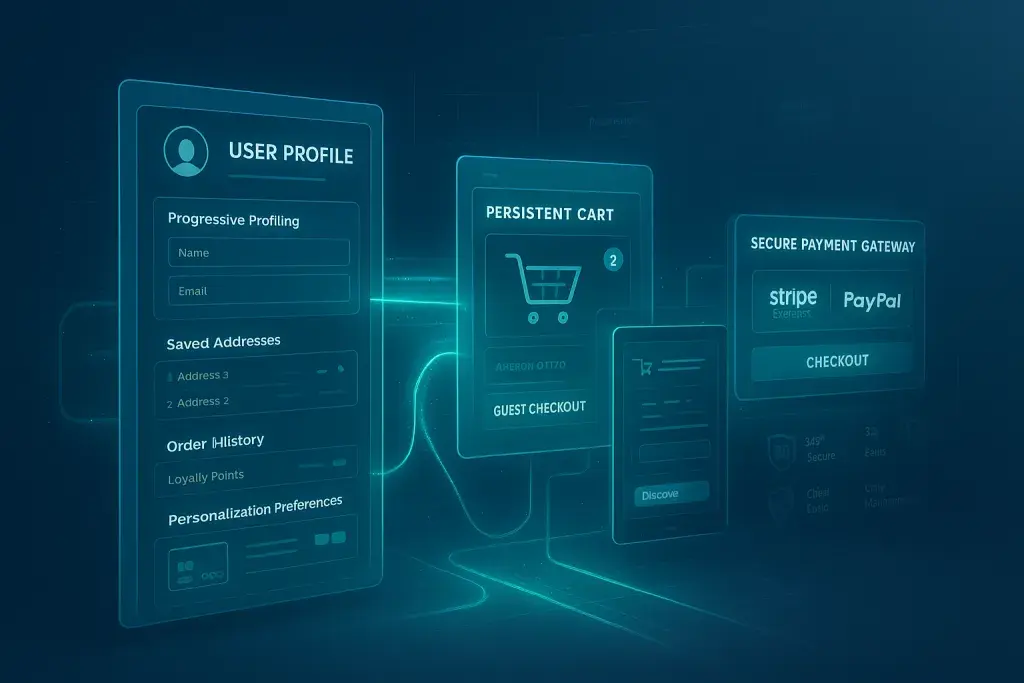
Most online shoppers do not abandon a purchase because they changed their mind. They leave because something in the experience broke their momentum - a form that asked for too much, a cart that forgot what they added, or a checkout page that felt unfamiliar and untrustworthy. The loss is quiet and immediate, and it happens millions of times a day across the web.
The architecture that prevents this kind of attrition sits across three interconnected systems: how a user profile is created and maintained, how the shopping cart preserves intent across devices and sessions, and how a payment gateway is embedded to make the final transaction feel secure and straightforward. When these three systems are designed well and connected properly, the experience becomes invisible in the best possible sense - customers move from product discovery to confirmed order without friction slowing them down. For merchants studying how identity-driven commerce is structured at scale, exploring how an account shop manages account-based access can provide useful perspective on how login, profile, and purchase intent intersect.
This article addresses each layer in sequence: the platform architecture that determines what is possible, the profile system that earns customer trust, the cart mechanics that hold purchase intent together, the payment integration that closes the sale, the unified checkout flow that connects all three, and the ongoing testing discipline that keeps the whole system performing. The guidance here applies whether you are building a new online store from scratch or refining one that has been running for years.
Understanding the Architecture of a Modern E-Commerce Platform
Every decision made at the architectural level shapes what is achievable in the layers above it. Before designing user profiles, engineering cart persistence, or integrating a payment gateway, it is worth understanding exactly what kind of platform you are working with - because the architecture defines the boundaries of flexibility, speed, and customization available to your team.
An e-commerce platform is not a single application. It is a collection of modules - identity management, product catalog, cart engine, order management, and payment processing - that must communicate reliably with one another. When those connections are well-engineered, the customer experience feels coherent. When they are fragile or poorly documented, every new feature becomes an exercise in managing technical debt.
Monolithic vs. Headless E-Commerce Architecture
The fundamental architectural choice facing most platform builders is whether to use a monolithic system - where the frontend and backend are bundled together - or a headless approach that decouples them entirely. Each has genuine advantages depending on your team's capabilities and your business's growth trajectory.
Monolithic platforms are faster to launch and require less engineering overhead. The tradeoff is reduced flexibility: customizing the user profile interface, the cart experience, or the checkout flow often means working within the constraints of the platform's default templates. For many small and mid-size stores, this is an acceptable limitation in exchange for lower upfront complexity.
Headless architectures give development teams full control over how every element is rendered - on web, mobile, and other surfaces - while backend services handle data and business logic independently. This is powerful, but it demands a higher level of engineering investment and ongoing coordination. Composable commerce takes this further, allowing teams to select best-in-class services for each function independently and connect them via APIs.
| Architecture Type | User Profile Flexibility | Cart Persistence Options | Payment Gateway Integration | Best For |
|---|---|---|---|---|
| Monolithic | Limited to platform defaults | Server-side sessions | Built-in or plugin-based | Small to mid-size stores |
| Headless | Fully customizable | API-driven, multi-device | Custom API integration | Scaling brands, custom UX |
| Composable | Service-specific | Dedicated cart microservice | Any gateway via API | Enterprise platforms |
| SaaS | Template-based | Platform-managed | Pre-approved gateways | Fast-launch businesses |
The right choice depends on where your platform sits today and where it needs to be in two to three years. Launching on a SaaS platform and migrating to a headless architecture later is a common and legitimate path. What matters is that the chosen architecture can actually support the user profile, cart, and payment capabilities your customers will expect.
Key Components Every E-Commerce Platform Must Have
Regardless of architectural approach, certain components are non-negotiable. These are not advanced features to be added once the core is stable - they are structural requirements for any online store that intends to convert and retain customers.
- Secure user authentication and encrypted profile storage
- Session-persistent shopping cart with cross-device synchronization
- Real-time inventory management tied to cart state
- Reliable payment gateway integration with clear error handling and fallback options
- Order history and profile management dashboard accessible to every registered user
- Data privacy compliance mechanisms aligned with applicable regulations
These components are interdependent. A cart that syncs across devices is only useful if the user profile system correctly identifies the same person on a phone and a laptop. Inventory accuracy is only meaningful if the cart engine respects it in real time. Each component reinforces the others, which is why they need to be designed together rather than added piecemeal.
Designing a User Profile System That Builds Trust and Loyalty
The user profile is where a customer's relationship with your platform lives. It holds their preferences, their history, their saved addresses, and - when handled correctly - a growing picture of what they care about. A well-designed profile system reduces friction at every future interaction. A poorly designed one makes customers feel like strangers on every visit.
The challenge is that building a rich profile and creating a frictionless onboarding experience are in direct tension with each other. Resolving that tension - collecting meaningful data without demanding too much upfront - is one of the more consequential design decisions an e-commerce platform team can make.
Registration and Onboarding: Minimizing Friction Without Losing Data
The registration form is the first real test of your platform's respect for the customer's time. Every additional required field is a small obstacle. Stack enough obstacles together and a motivated buyer becomes an anonymous browser who never returns.
The practical answer is not to collect less data - it is to collect it differently. Progressive profiling distributes data collection across multiple touchpoints over time, rather than demanding everything at once during sign-up. A customer who registers with just an email address and password on day one might voluntarily add a shipping address when they place their first order, and set communication preferences after their second purchase.
- Offer guest checkout as the default option, with account creation presented at order confirmation rather than before it
- Provide social login options to eliminate password-related drop-off
- Use progressive profiling to gather additional data gradually across multiple sessions
- Communicate clearly what benefit account creation provides - order tracking, saved addresses, early access to promotions
- Implement email verification without blocking immediate access to the store
One principle worth stating plainly: forcing account creation before checkout is a reliable way to lose customers who are otherwise ready to buy. The moment a purchase intent is blocked by a mandatory form, the conversion window closes for a meaningful share of your audience.
Profile Dashboard: What to Include and How to Organize It
Once a user has created an account, the profile dashboard becomes their home base on the platform. It should be organized around the tasks customers actually perform - tracking orders, updating addresses, reviewing past purchases - not around the data categories that are easiest for your backend to expose.
A well-organized profile dashboard typically contains:
- Order history with current status and a direct reorder option
- Saved shipping addresses with a clear default designation
- Saved payment methods displayed with masked details (card type and last four digits only)
- Wishlist and saved-for-later items with stock status indicators
- Communication preferences and notification settings the user controls directly
- Loyalty points or rewards balance if the platform supports a loyalty program
- Account security settings including password management and two-factor authentication
Clarity and control are the two design principles that matter most here. Customers who can find what they need quickly and who feel confident that their data is managed transparently are significantly more likely to return. Those who cannot find their order history without three clicks, or who cannot locate where to change their default address, quietly lose confidence in the platform.
Personalization Through Profile Data
Profile data is the raw material of personalization. Purchase history, saved items, browsing behavior, stated preferences, and location signals can all be used to make each customer's experience feel tailored rather than generic. Product recommendations, targeted promotions, and dynamic homepage content are the most common applications of this data.
The critical discipline here is transparency. Personalization that customers understand and can control tends to be welcomed. Personalization that appears without explanation - where a customer cannot figure out why they are seeing certain products or receiving certain emails - tends to feel invasive, even when the underlying logic is benign. Building clear preference controls into the user profile dashboard, and surfacing them proactively rather than burying them in settings menus, is both a trust-building measure and a practical approach to data quality. Customers who actively set their preferences give you more accurate signals than customers whose behavior you are trying to infer.
Building a Shopping Cart Experience That Retains Intent Across Sessions
A shopping cart is not just a staging area for products before checkout. It is the most direct expression of a customer's purchase intent, and it needs to be treated accordingly. When a cart loses items because a session expired, or fails to sync between a mobile browse and a desktop checkout, the platform has broken a promise it implicitly made the moment the customer clicked "add to cart."
The engineering and UX decisions behind a well-functioning cart are not glamorous, but they have a direct and measurable impact on revenue. Getting them right is one of the highest-leverage investments an e-commerce platform can make.
Persistent vs. Session-Based Carts
The choice between session-based and persistent cart storage shapes everything downstream - from abandoned cart recovery to cross-device purchasing behavior. Session-based carts expire when the browser closes, which means any customer who adds a product, gets interrupted, and returns later will find an empty cart. Persistent carts store cart data server-side and restore it whenever the customer returns, regardless of device or time elapsed.
| Cart Type | Data Storage | Login Required | Cross-Device Sync | Abandoned Cart Recovery |
|---|---|---|---|---|
| Session-based | Browser cookie or session | No | No | Not possible |
| Persistent (guest) | Cookie plus local storage | No | Limited | Limited - requires email capture |
| Persistent (logged in) | Server-side database | Yes | Full | Full automation possible |
For any online store that takes conversion seriously, persistent cart storage for logged-in users is a baseline requirement, not an optional enhancement. The ability to recover abandoned carts through automated email sequences - which is only possible when cart state is stored server-side - alone justifies the engineering investment.
Cart State Management and Real-Time Inventory Sync
One of the most damaging experiences a customer can have on an e-commerce platform is adding a product to their cart, completing the checkout flow, and then being informed at the payment step that the item is out of stock. This failure is almost always caused by a disconnect between the cart engine and the inventory management system - a technical problem with a predictable customer impact.
Solving it requires treating inventory as a live data layer that the cart reads continuously, not a static value checked only at checkout.
- Reserve inventory tentatively when an item is added to the cart, with a configurable timeout of roughly fifteen to thirty minutes
- Display real-time stock availability directly within the cart interface, particularly for low-stock items
- Notify users proactively when a carted item is running low so they can decide whether to proceed
- Release reserved stock automatically when a cart is abandoned beyond the timeout window
- Handle concurrent additions for limited-stock items with proper conflict resolution to avoid overselling
These mechanics require coordination between the cart service and the inventory system, but the customer experience benefit is substantial. A platform that reliably shows accurate availability - and never surprises customers with a stock-out at checkout - builds a level of trust that generic stores rarely achieve.
Abandoned Cart Recovery Strategies
Cart abandonment is a normal feature of online retail. Customers add items speculatively, compare across multiple sites, get distracted, or simply run out of time. The question is not how to eliminate abandonment - it is how to recover a meaningful share of it.
A structured recovery sequence, triggered automatically when a cart is abandoned, can recapture purchases that would otherwise be permanently lost. The timing and content of each message in the sequence matter considerably.
- Send the first recovery email within one hour of abandonment - this is when purchase intent is still warm and the competing stimulus has not fully taken hold
- Include a direct link back to the populated cart, not to the homepage or a category page
- Send a second email at the twenty-four-hour mark, which can include a value-add such as a free shipping offer or a relevant product review
- Send a final email at seventy-two hours - this is an appropriate moment for a limited-time incentive if the platform's margin structure supports it
- Use browser push notifications as a supplementary channel for logged-in users who have opted in
- Retarget anonymous cart abandoners via paid social channels using pixel-based audiences where applicable
A three-message sequence with well-timed sends and personalized product images in each email consistently outperforms single-message recovery attempts. The key variable is relevance: the recovery message should show the customer exactly what they left behind, not a generic prompt to return to the store.
Integrating Payment Gateways for a Secure and Frictionless Checkout
The payment step is where purchase intent converts into revenue - or fails to. Every unnecessary friction point in the payment flow, every moment of visual inconsistency that triggers doubt about security, and every error message that leaves a customer without a clear path forward is a conversion that did not happen. The quality of the payment gateway integration is not an infrastructure detail; it is a direct driver of business outcomes.
How Payment Gateways Work Within an E-Commerce Platform
Understanding the technical flow of a payment transaction helps clarify why certain integration decisions matter. A payment gateway is the technology layer that securely transmits payment data from the customer to the financial institutions involved in authorizing the transaction.
The flow for a standard card payment proceeds as follows:
- The customer enters payment details on the checkout page
- The gateway encrypts the data and transmits it to the payment processor
- The processor contacts the customer's issuing bank to request authorization
- The bank returns an authorization result - approved or declined - to the processor
- The processor communicates that result to the gateway
- The gateway passes the outcome to the e-commerce platform, which triggers either an order confirmation or an error state
It is worth distinguishing between a payment gateway and a payment processor, since the terms are often used interchangeably but describe different functions. The gateway handles the secure transmission of data; the processor manages the actual movement of funds between financial institutions. Many providers combine both functions in a single integration, which simplifies implementation considerably for most platform operators.
Comparing Major Payment Gateway Options
Selecting a payment gateway involves evaluating several dimensions in parallel: transaction fees, the range of supported currencies and countries, the quality of the developer API, the fraud prevention tools available, and the checkout experience the gateway enables for the end customer.
| Gateway | Embedded Checkout Option | Fraud Prevention Tools | Global Reach | Best Fit |
|---|---|---|---|---|
| Stripe | Yes - Stripe Elements | Stripe Radar | Strong, 40+ countries | Developer-led teams, custom UX |
| PayPal | Yes - PayPal Buttons | Built-in | Very broad, 200+ countries | Global reach, recognized trust signal |
| Braintree | Yes - Drop-in UI | Advanced rules engine | Strong, 40+ countries | Subscription and recurring billing |
| Adyen | Yes | RevenueProtect | Very broad, enterprise-grade | Large-scale e-commerce platforms |
| Square | Yes | Moderate | Limited internationally | Omnichannel - online and in-person |
No single gateway is the right answer for every platform. The decision should be driven by where your customers are located, what payment methods they expect to use, what your team's technical capacity looks like for integration and maintenance, and what your transaction volume implies about fee structures over time.
Embedded Checkout vs. Redirect-Based Payment Flows
There are two primary ways to present the payment step to a customer. In an embedded checkout, the payment form lives directly within your platform's checkout page, maintaining visual consistency throughout the entire purchase flow. In a redirect-based flow, the customer is sent to a page hosted by the payment gateway to enter their details, then returned to your platform after authorization.
- Embedded checkout maintains brand continuity throughout the checkout process, which reduces the trust disruption that can occur when a customer is suddenly looking at an unfamiliar page
- Redirect-based flows are simpler to implement and offload the complexity of PCI DSS compliance to the gateway, since payment data never touches your servers directly
- Embedded checkout using tokenized card input fields - such as Stripe Elements or Braintree's Drop-in UI - achieves the brand consistency of embedded checkout while still offloading PCI scope, making it the recommended default for most implementations
The customer perception difference between a polished embedded checkout and a jarring redirect is not trivial. The visual shift to a third-party page during payment raises subconscious questions about where the data is going and who is responsible for it - questions that an embedded experience never triggers.
Security, PCI Compliance, and Fraud Prevention
Every online store that processes card payments operates within a compliance framework established by the payment card industry. The Payment Card Industry Data Security Standard (PCI DSS) defines the security controls required of any entity that handles cardholder data. Non-compliance is not a theoretical risk - it carries real financial and operational consequences, including fines and the potential loss of payment processing rights.
The good news is that using a reputable payment gateway with tokenized card input fields dramatically reduces the scope of PCI DSS obligations for most platform operators, since raw card data never passes through or is stored on your infrastructure.
- Never store raw card numbers on your servers - use the tokenization system provided by the gateway
- Enforce HTTPS across the entire platform, not just the checkout page
- Implement 3D Secure authentication where required by regulation or where fraud risk justifies the additional step
- Configure gateway-provided fraud scoring tools with thresholds appropriate to your transaction profile
- Enable velocity checks to flag unusual purchasing patterns - multiple orders in quick succession from the same IP or device, for instance
- Log all payment events systematically and monitor them for anomalies
Fraud prevention is not a one-time configuration. It requires ongoing attention as fraud patterns evolve. A risk-based approach - applying stricter verification to higher-value or statistically anomalous transactions - balances security with the conversion impact of adding friction to legitimate purchases.
Connecting the User Profile, Shopping Cart, and Payment Gateway into a Unified Checkout Flow
Each of the systems described in the preceding sections has its own engineering requirements and design considerations. But from a customer's perspective, they are not separate systems at all - they are a single, continuous experience that begins when they land on a product page and ends when they receive an order confirmation. The integration between these components is where the quality of the overall platform is ultimately judged.
A unified checkout flow draws on the user profile for pre-populated data, relies on the shopping cart for accurate order state, and depends on the payment gateway for a secure and reliable transaction. When the handoffs between these systems are invisible - when data flows automatically and accurately without requiring the customer to re-enter information they have already provided - the experience earns a level of trust that keeps customers coming back.
Pre-Populating Checkout with Profile Data
For logged-in users, the checkout process should be as close to one-click as your platform's risk tolerance and regulatory requirements allow. The user profile holds everything needed to pre-populate the shipping address, preferred shipping method, and saved payment method. Surfacing this data automatically at checkout removes the most tedious part of the purchase process for returning customers.
- Detect login status at the cart review page and display relevant saved data immediately
- Show the default shipping address with a clearly accessible option to select a different address or add a new one
- Display saved payment methods with masked details - card type and last four digits - allowing the customer to confirm or switch
- Enable one-click checkout for returning customers when all defaults are pre-selected and the order total is confirmed
- Present the final order total - including taxes, shipping costs, and any applied discounts - before the payment submission step
The underlying principle is simple: every piece of data the platform already has should never be requested from the customer again. Doing so signals either poor system integration or a disregard for the customer's time, neither of which builds confidence in the platform.
Handling Guest Checkout and Post-Purchase Account Creation
A meaningful share of customers will always prefer to complete a purchase without creating an account. Accommodating this preference is not a concession - it is a sound conversion decision. Blocking a customer who is ready to buy behind a mandatory registration form is one of the most common and easily avoidable causes of checkout abandonment.
The post-purchase moment offers a far more effective opportunity to convert guest buyers into registered users. After the order is confirmed and the customer's satisfaction is at its peak, a prompt to create an account - pre-populated with the email address and order details already captured - requires minimal additional effort from the customer and delivers clear value through order tracking and saved preferences. This approach converts more guest buyers into account holders than mandatory pre-purchase registration, while maintaining a frictionless checkout experience for those who ultimately decline.
Error Handling and Payment Failure Recovery
Payment failures happen. Cards get declined, network connections time out, and authentication challenges occasionally fail. The question is not whether your platform will encounter payment errors, but whether it handles them in a way that preserves the customer's willingness to try again.
A poorly handled payment failure - one that clears the cart, returns a generic error code, and provides no guidance - leaves the customer with no clear next step and a diminished level of confidence in the platform. A well-handled failure keeps all order data intact and gives the customer an actionable path forward.
- Display specific, actionable error messages that explain what went wrong and what the customer can do next - for example, indicating that a card was declined and suggesting the customer try a different payment method or contact their bank
- Never clear the cart or reset the order form when a payment fails
- Surface alternative payment methods immediately after a failure, without requiring the customer to navigate back to the payment step manually
- Log all payment failures systematically for pattern analysis - recurring failures from specific card types or geographic regions can indicate configuration issues
- Apply automatic retry logic selectively for network-related timeouts, but not for explicit card declines, where retrying without customer action is unlikely to succeed
Testing, Optimization, and Ongoing Maintenance of the Integrated Experience
Building a well-integrated platform is not a one-time achievement. The systems that handle user profiles, shopping carts, and payment gateways all evolve - through platform updates, API version changes, shifting customer behavior, and new regulatory requirements. Without a deliberate approach to testing, measurement, and maintenance, even a well-built integration will degrade over time.
Key Metrics to Track Across All Three Systems
Improvement requires measurement. Each component of the checkout experience generates data that reveals where customers succeed and where they drop off. Tracking these metrics consistently allows teams to identify problems before they become significant revenue drains and to validate the impact of changes made to improve the experience.
| System | Key Metric | What It Reveals | Primary Optimization Direction |
|---|---|---|---|
| User Profile | Registration completion rate | Onboarding friction level | Reduce required fields, add social login |
| User Profile | Profile completeness score | Data quality for personalization | Progressive profiling prompts over time |
| Shopping Cart | Cart abandonment rate | Checkout friction and intent strength | Improve checkout UX, activate recovery sequences |
| Shopping Cart | Cart-to-checkout rate | Cart review page clarity | Simplify cart interface, surface trust signals |
| Payment Gateway | Authorization rate | Technical and fraud-related failures | Add retry logic, optimize 3D Secure flow |
| Payment Gateway | Checkout-to-payment completion rate | Payment form friction and trust | Reduce form fields, add visible security indicators |
These metrics should be reviewed regularly, not only when a problem is suspected. Gradual declines are harder to detect than sudden drops, but they can represent equally significant revenue impacts over time.
A/B Testing Strategies for Checkout Optimization
Structured testing is the most reliable method for identifying improvements to the checkout experience. Rather than making broad changes based on intuition or anecdotal feedback, A/B tests isolate individual variables and measure their impact on conversion with statistical confidence.
The most productive areas to test within a checkout flow include:
- Single-page vs. multi-step checkout layout - the right choice depends on your product type and average order complexity
- Placement, size, and phrasing of trust signals such as security badges and return policy reminders
- Guest checkout vs. registered account as the default option presented at checkout entry
- Button copy and visual hierarchy at the payment submission step
- The order in which payment methods are displayed - the first option tends to receive disproportionate selection
- Presence and timing of exit-intent prompts within the checkout flow
A test plan should prioritize high-traffic, high-impact pages first. The checkout confirmation step and the payment entry screen typically generate the most actionable data because they are closest to the conversion moment.
Keeping Integrations Updated and Secure
Payment gateway APIs are updated regularly. Authentication libraries receive security patches. E-commerce platform dependencies change. Each of these updates carries some risk of breaking existing functionality if not managed carefully - and the risk of not applying them is almost always higher than the risk of applying them with proper testing.
- Subscribe to security advisories from all payment gateway providers your platform uses and act on them promptly
- Schedule quarterly reviews of all third-party library versions involved in the checkout flow, not only payment-related ones
- Test the complete checkout flow end-to-end in a staging environment before deploying any update to production
- Conduct an annual review of your PCI DSS compliance posture, particularly if your integration approach or transaction volume has changed
- Monitor payment gateway API endpoint uptime and response times with automated alerting so that degraded performance is detected before customers report it
The maintenance discipline required to keep a payment integration reliable and secure is not complicated, but it does require consistency. Teams that treat integration maintenance as a scheduled activity rather than a reactive one experience fewer critical failures and spend less time on emergency remediation.
Questions and Answers
When should a user profile be created - before or after the first purchase?
For most e-commerce platforms, the highest-converting approach is to allow guest checkout by default and present account creation at the order confirmation step. At that point, the customer is satisfied, the transaction is complete, and the email address has already been captured - so account creation requires minimal additional effort. Requiring profile creation before checkout consistently reduces conversion rates.
How should a shopping cart handle items that go out of stock while sitting in the cart?
The cart should display a clear, in-context notification when a carted item is no longer available or has dropped below the requested quantity. The customer should be able to remove the unavailable item and proceed with the rest of the order without starting the checkout process over. Hiding the stock issue until the payment step is one of the most damaging experiences a platform can create for a customer who has already invested time in the checkout flow.
Is it necessary to support multiple payment gateways, or is one sufficient?
A single primary gateway that handles card payments is sufficient for many platforms at launch. Adding one or two digital wallet options - such as PayPal, Apple Pay, or Google Pay - captures customers who prefer those methods and provides a fallback when card payments fail. Beyond that, the case for additional gateways depends on the geographic markets you serve and the payment methods that are standard in those regions. More gateways add integration and maintenance complexity, so each addition should be justified by measurable demand.
What is the most common cause of payment authorization failures, and how can it be reduced?
The most frequent cause of authorization failures is a mismatch between the billing address entered at checkout and the address on file with the issuing bank. Ensuring that your checkout form clearly labels the billing address field and distinguishes it from the shipping address reduces this class of error. Additionally, offering 3D Secure as a verification fallback for borderline transactions can convert some declines into successful authorizations by giving the issuing bank additional confidence in the transaction.
How can a platform sync a guest cart with a registered account when the user logs in mid-session?
When a guest user logs in after adding items to their cart, the platform should merge the guest cart with the account's existing saved cart automatically. The standard approach is to add the guest cart items to the account cart, while flagging any duplicate products so the customer can confirm the intended quantity. Cart contents should never be discarded silently during a login event - losing items the customer deliberately selected is a clear failure of the platform's basic responsibility to preserve purchase intent.
How often should the checkout flow be tested after the initial launch?
The checkout flow should be tested end-to-end after every platform update, payment gateway API change, or significant change to the order management system - not only during scheduled maintenance cycles. In practice, this means establishing an automated testing suite that covers the critical path from cart review through payment confirmation and can be run before any deployment. Manual testing by a team member should supplement automated checks, particularly for edge cases like payment failure handling and cart merging behavior.


