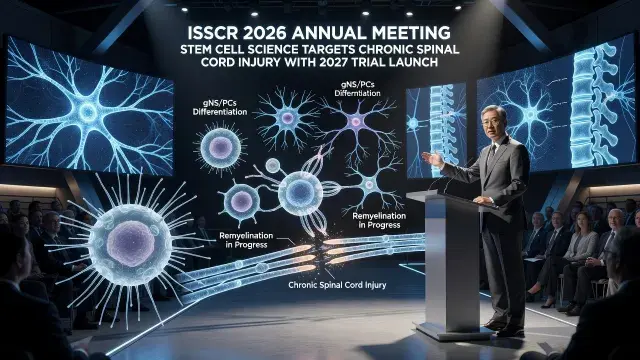
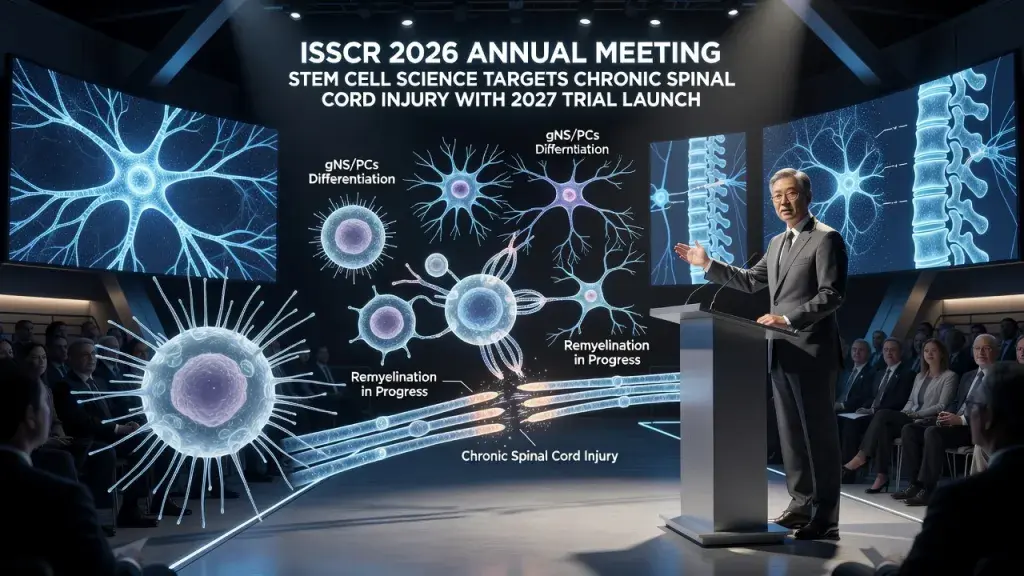
Researchers have presented a significant preclinical breakthrough in the treatment of chronic spinal cord injury, raising cautious but genuine hope for millions of patients worldwide who currently have no effective restorative therapy available to them. The findings were unveiled at the International Society for Stem Cell Research (ISSCR) 2026 Annual Meeting by Dr. Hideyuki Okano of Keio University, Japan, who also serves as ISSCR's president. A physician-initiated clinical trial targeting this patient population is now being planned, with recruitment expected to begin in 2027.
The research centers on clinical-grade gliogenic neural stem/progenitor cells - known as gNS/PCs - a cellular approach specifically designed to address the unique biological obstacles that distinguish chronic spinal cord injuries from acute or subacute cases. Understanding why this distinction matters requires a brief step into the biology involved: in chronic injuries, the nerve fibers themselves often survive but lose their protective myelin sheath, leaving them effectively dormant. Previous therapeutic strategies focused largely on generating entirely new neurons, an approach that, much like betting on an unfamiliar slot bgaming outcome with incomplete information, carries significant uncertainty when the underlying wiring is still partially intact. Dr. Okano's team has taken a fundamentally different position: rather than rebuilding from scratch, the goal is to restore and reactivate what already exists.
In preclinical models, the gNS/PCs demonstrated an ability to differentiate into the key support cells of the central nervous system - astrocytes and oligodendrocytes - while also producing neurons. Crucially, following transplantation into chronic injury models, the cells promoted measurable behavioral recovery, remodeled the injured microenvironment, and did so without forming tumor-like tissue. That last point is not a minor footnote: the absence of aberrant tissue growth is one of the core safety benchmarks any stem cell therapy must clear before advancing to human trials.
Building on a World-First Safety Record
This new push into chronic SCI does not emerge from a standing start. Dr. Okano's team has already completed what he describes as a world-first, first-in-human clinical study in patients with subacute spinal cord injury - those treated in the earlier window following injury - and the results demonstrated a promising safety profile. That foundational work is what gives the transition to chronic patients its scientific credibility. "Our shift to the chronic phase is the next logical milestone, built upon that solid foundation," Okano stated at the conference. "Since the cellular environment changes over time, we are evolving our strategy from just establishing safety to actively overcoming the stubborn, long-standing barriers of chronic paralysis."
The forthcoming trial will specifically target patients with incomplete chronic SCI - individuals who retain nerve fibers that are demyelinated and inactive but structurally present, and who lack sufficient endogenous cellular support to trigger natural recovery. This patient selection is deliberate and scientifically sound: the remyelination strategy only makes sense where there is existing circuitry to restore. Patients with complete cord transections, where no viable fibers remain, would not benefit from this particular approach.
What a Successful Trial Could Mean
The stakes extend well beyond the laboratory. Chronic spinal cord injury affects hundreds of thousands of people globally, and the burden is particularly acute in lower-to-middle-income contexts across parts of Africa, South Asia including India, and Latin America, where rehabilitation infrastructure is often limited and long-term care is difficult to sustain. A safe, standardized cellular therapy capable of restoring even partial voluntary movement or autonomic function - bladder control, for instance - would be transformative not just clinically but in terms of quality of life and economic participation for patients and their families.
The research is still preclinical in its efficacy data for this chronic population, and the path from animal models to confirmed human benefit is one that medical science has learned, repeatedly, to treat with discipline and patience. Dr. Okano's team is not claiming a cure. What they are presenting is a biologically coherent strategy, a clean safety record in earlier-phase human work, and a clearly structured next step. If the 2027 trial proceeds on schedule and the data hold, it could mark the beginning of the first genuinely restorative therapeutic option for one of medicine's most resistant conditions.